
As healthcare leaders, we are navigating a rapidly shifting environment where the competition for top clinical and nonclinical talent grows more intense by the day. Traditional incentives are no longer enough to attract, engage, and retain the professionals our organizations need to lead and deliver care.
Two priorities now stand out as true strategic imperatives: flexibility and career growth.
Flexibility: A New Standard for Workforce Engagement
Today’s healthcare professionals want more than a paycheck
They want autonomy, balance, and the ability to shape their work in ways that align with life outside of it.
Flexible scheduling, hybrid roles, and telehealth opportunities are not perks anymore
They are expectations. Organizations that embrace flexibility report stronger workforce engagement, lower turnover, and greater operational resilience
📊 Just look at the numbers:
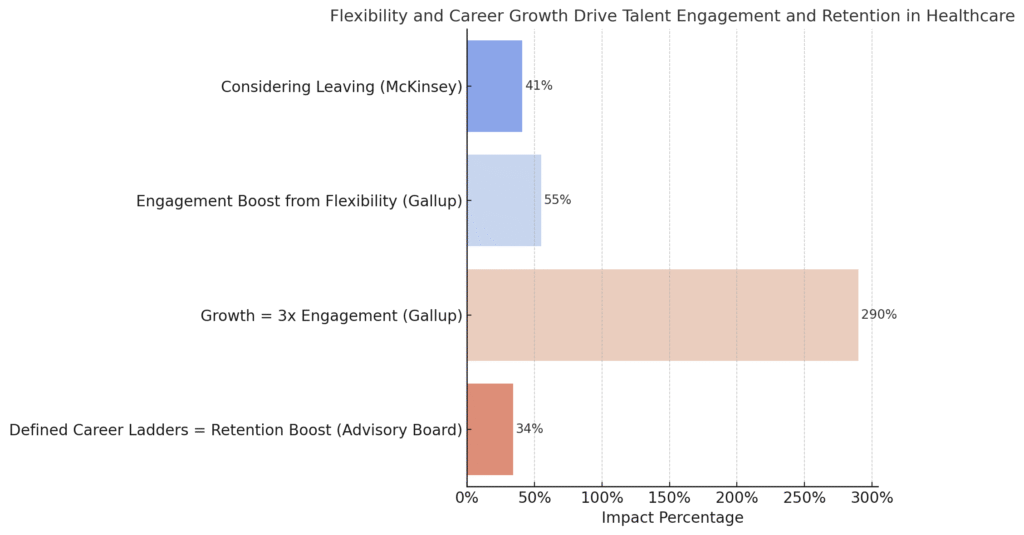
Flexibility and Career Growth Drive Talent Engagement and Retention in Healthcare
- 41 percent of healthcare workers are considering leaving their jobs (McKinsey)
- 55 percent boost in engagement when flexible work options are present (Gallup)
- 2.9 times higher engagement when employees feel they can learn and grow (Gallup)
- 34 percent higher retention in organizations with clear career ladders (Advisory Board)
Questions for executive teams to consider:
- Are we offering flexible options that genuinely reflect the needs of a diverse workforce?
- How are we using technology to enable smarter, more adaptive scheduling?
Career Growth: The Foundation of a Future Ready Workforce
Top talent is drawn to organizations that invest in growth, not just productivity.
Structured career pathways, mentorship, and ongoing learning do more than attract strong candidates.
They build loyalty, boost performance, and strengthen internal leadership pipelines.
When professionals see a future with you, they are more likely to stay, contribute, and lead.
Ask yourself:
- Are our advancement pathways transparent, inclusive, and accessible across roles?
- How are we promoting cross training, professional development, and internal mobility?
The Executive Opportunity
Flexibility and career growth are not line items in a benefits package
They are culture signals, leadership choices, and operational strategies.
When done right, they lead to
- Improved retention
- Higher patient satisfaction
- Stronger positioning as an employer of choice
As executives, this is our opportunity to lead from the front
Not just to fill roles, but to build environments where healthcare professionals choose to stay and grow.
Let’s redefine what it means to build a workforce in healthcare, where flexibility and growth are not extras, but essentials
How is your organization responding to these workforce shifts?